
A winning regular symbol type is removed across the board, including copies outside the winning group. Each affected position also loses a layer. Dynamite can remove an affected layer; hitting Wild Dynamite triggers a local 3 × 3 clear. Coins award prizes, clovers boost values, and Collectors add their own interactions. Calculate net result from the full charge and final return.
The Three-Layer Grid
Le Digger runs on a six-reel cluster-pays layout, and the defining idea is that the visible symbols are only the top of three stacked layers. According to Hacksaw Gaming, the first two layers contain regular paying symbols, free spin scatters and Wild Dynamite, while the third layer holds Golden Reveals. You are not spinning a flat grid; you are excavating one. Every removal event exposes what sits underneath, so a single paid spin can produce a long chain of reveals before the round settles.
The practical consequence is that the state of the grid matters more than the state of any single spin. A cluster win near the surface is worth less in positional terms than the same win sitting directly above the third layer, because only the second case can expose a Golden Reveal. When you watch a round, track depth rather than just the win amount: count how many positions have been dug through to layer three, since those are the only positions capable of producing coins, clovers or collectors.
Imagine one position as a small shaft with three floors. Removing its first layer exposes the second. Removing the second exposes a Golden Reveal. The neighbouring position can remain at a different depth. This is why a board can display ordinary symbols beside coins and clovers without being a different game mode. Depth is attached to positions, not to a single global counter.
Follow the stages inside one current round before drawing conclusions about later spins. The provider summary does not give a full reset specification for every state. Our explainer resets when you press Start again because it is a teaching model, not because that button demonstrates a verified game rule. Bonus-specific state, such as the Blast Bar, is explained separately.
Follow one position through the three layers
An explanatory model, not a playable slot. Each button shows the next stage at one position after a qualifying removal. Actual symbols and outcomes vary.
Layer 1 · regular symbol
The position starts at the top layer. A qualifying win or dynamite can remove its symbol and expose the layer underneath.
Why One Position Can Matter More Than One Win
Because Golden Reveals live only on the third layer, the value of a removal is positional, not just monetary. A modest cluster that finishes digging a column down to layer three can be worth more to the round than a larger cluster that only shuffles symbols around on layer one. When you evaluate a cascade, ask a simple question per position: did this removal open new ground, or did it just pay?
Try a simple overlap exercise. Six positions are on layer two. A qualifying removal affects five positions, three of which belong to that group of six. Those three now expose layer three. If the other two affected positions were on layer one, they move to layer two. Three positions expose Golden Reveals; two do not yet reach them. The example fixes the initial depths so you can check the counting without guessing random outcomes.
This framing also explains why dead spins feel different in Le Digger than in a flat slot. A spin that pays a small amount but opens three third-layer positions has done structural work; a spin that pays the same amount on the surface has not. Neither guarantees anything, because what the third layer reveals is still determined by the game's random outcome, but the number of exposed deep positions is a fair way to describe how much of the grid's feature potential was actually unlocked during that round.
Keep the distinction clean: position depth is visible and countable, while the contents of a reveal are not predictable. You can verify the first with your own eyes on any round; you cannot infer the second from depth, streaks or previous reveals.
Sources for this section: provider
How Symbol Removal Actually Works
The removal rule in Le Digger is broader than a standard cluster clear. Per the provider, a win removes all regular paying symbols of the winning type across the grid, including instances that are not part of the winning cluster, and it also removes one layer behind them. That second clause is the engine of the whole game: every win digs.
Suppose eleven lantern symbols are present and a qualifying group of lanterns wins under the paytable. Le Digger removes the eleven regular symbols of that type, even those outside the group. If seven of their positions were on layer one and four on layer two, seven expose layer two and four expose layer three. That is eleven removals and one layer per affected position. It does not mean the four deeper positions received an additional symbol payout.
This global-removal rule cuts both ways. Symbols of the winning type that were sitting in useful deep positions also vanish, which is fine, but it also means the symbol mix on the grid changes more violently than in a normal cascade game. After a win, the grid is refilled and the round continues, and it is at this point that Smokey may throw dynamite, which is a separate event with its own removal behaviour.
A practical check while playing: before each cascade resolves, note which symbol type dominates the board. If that type wins, expect a large fraction of the grid to clear at once, because every copy goes. If a rare type wins, expect a surgical removal. Watching this a few times makes the game's volatility texture much easier to read than staring at the win counter.
Sources for this section: provider
Smokey's Dynamite and Wild Dynamite
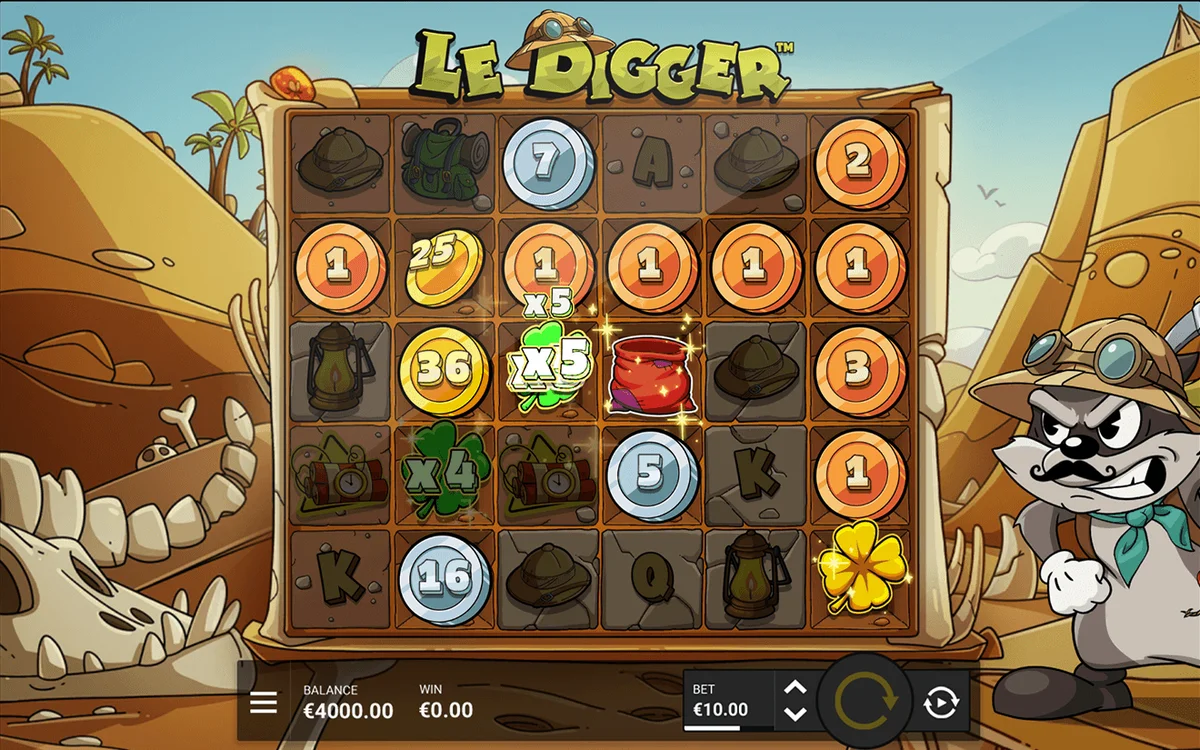
After new layers and symbols appear following a win, Smokey may throw dynamite. The provider describes two effects: the dynamite removes the affected symbols and removes a layer behind them, and if the dynamite affects a Wild Dynamite symbol, that Wild Dynamite clears a 3x3 area around itself. Dynamite is therefore both a removal tool and a digging tool, and it can chain into a much larger clear when Wild Dynamite is involved.
The 3 × 3 description refers to a local square around the affected Wild Dynamite. It helps distinguish that local effect from clearing a regular symbol type across the whole board. A complete client rule is needed to settle edge cases, overlapping effects and any additional interactions. Do not infer a fixed nine-cell payout or a particular number of coins from the geometric area.
For the depth part of the rule, imagine a later dynamite hit at a position that a win already moved from layer one to layer two. The hit removes the second layer and exposes the third. Both events belong to the illustrated sequence; neither creates a separate charge simply because another animation plays. In the actual client, the final balance and settlement record are the way to identify the charged entry.
Smokey may throw dynamite after new layers and symbols appear. That word matters: ordinary play does not promise a throw on every refill. A visible Wild Dynamite also needs the specified activation condition. The Gold Digger feature changes the throw provision to five per free spin, but it still does not promise a particular returned amount.
Sources for this section: provider
Coins and Golden Reveals
Coins award cash prizes when revealed at the third layer, according to the provider. A Collector is an additional interaction, not a stated prerequisite for every coin prize. That distinction matters because it prevents a common reading error: seeing a coin without a nearby bag does not justify marking the coin as a lost or unpaid prize.
The numbers on coins need the client’s own unit explanation. A displayed 7 might be a multiple or another game-defined value; the promotional crop alone is not a cash conversion table. When the help panel supplies the unit, use that same denominator consistently. Do not multiply a value by both the base stake and the full feature price unless the rules explicitly require it.
In purely illustrative units, coins of 1, 2 and 5 total 8. If a stated effect doubles all three, their new values total 16. That is a demonstration of addition and multiplication, not an observed Le Digger award. The actual event order and total credited amount must come from the client, especially when several modifiers or Collectors activate.
Sources for this section: provider
Read the Golden Reveals

Coin
A cash prize revealed at the third layer.
Clover
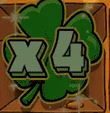
Boosts nearby coins or all coins, depending on the clover.

Collector
Collects coins and already activated Collectors.
Green and Gold Clovers
Clovers are the coin modifiers. The provider states that clovers affect nearby coins or all coins, and that Golden Reveals include both green and gold clovers. What the provider does not state publicly is an exact mapping of which colour does which effect, so we will not claim one. The safe reading is: one clover behaviour applies to coins in a nearby area, and another applies to every coin on the grid, with green and gold being the two variants. Confirm the colour-to-effect mapping in the paytable of the client you actually use.
The difference between 'nearby' and 'all' is large in arithmetic terms. Say the grid holds 6 coins worth 1, 1, 2, 2, 5 and 5 units, totalling 16. A doubling effect applied to a nearby cluster of 3 of those coins, say the 1, 2 and 5, changes the total to 2 + 4 + 10 + 1 + 2 + 5 = 24, a gain of 8. The same doubling applied to all 6 coins gives 2 + 2 + 4 + 4 + 10 + 10 = 32, a gain of 16. An 'all coins' clover is worth exactly twice a 'nearby' clover in this example, and the ratio shifts with how many coins sit outside the nearby zone.
Read the applicable effect and the displayed coin values before trying to reconstruct a total. If a rule says a value is multiplied, calculate that operation once. Do not add the old and new values together as if both were separate credits. The provider summary does not specify every activation-order rule, so this guide does not claim that a late clover is always wasted or that collected coins always disappear.
The source confirms nearby-coin and all-coin effects but does not establish the colour mapping used in this guide. That is a specific information gap, not evidence that every other description is wrong. The exact in-client help is the appropriate reference when matching a green or gold clover to its affected area.
Sources for this section: provider
Collectors and Collection Chains
The provider says Collectors collect coins and already activated Collectors. This means an activated Collector can become part of a later collection, rather than only ordinary coin symbols being relevant. It is a feature interaction layered on top of coin prizes. The bag-shaped symbol in our small crop helps you recognise it amid a busy board.
Be careful about inventing settlement rules from this sentence alone. It does not say that each coin is collected exactly once, that the last bag replaces earlier awards or that a Collector reaches only nearby positions. Those assumptions could produce a very different total. A numerical Collector-chain simulation would need the complete rules, so this guide keeps the explanation at the verified level.
When reading a completed round, separate the feature display from the settled account total. A bag may show an accumulated value while the win meter includes an earlier award. Adding all visible counters can double-count the same amount. Use the final credited return and charged entry price for net profit; use the animation to explain how the feature unfolded.
Tomb Service has a Dynamite Collector that activates at the end of the bonus. That named bonus mechanism should not be silently substituted for a regular Golden Reveal Collector. The former has its own collection conditions, described by the UK operator as involving winning Wild Dynamite. Neither name licenses a claim that uncollected coins from every spin are saved until the end.
Free Spin Triggers: Tomb Service, Dig It and Gold Digger
Le Digger has three scatter thresholds, and each unlocks a mechanically distinct bonus rather than a bigger version of the same one. Three scatters trigger Tomb Service: you choose between a Gamble option or 10 free spins, and the round features a Dynamite Collector that activates at the end. Four scatters trigger Dig It: again a choice of Gamble or 10 free spins, and here a Blast Bar fills with removed symbols; when full, it upgrades the minimum coin type. Five scatters trigger Gold Digger: 10 free spins with 5 dynamites on every spin.
The distinguishing feature of Tomb Service is its final Dynamite Collector activation. Dig It uses the Blast Bar and an upgrade to the minimum coin type. Gold Digger provides five dynamites on each of its ten initial free spins. Five times ten describes fifty scheduled throws if those ten spins are played; it does not specify fifty distinct positions, fifty prize events or a return distribution.
The Gamble choice in Tomb Service and Dig It is offered instead of the 10 free spins. We do not have verified odds or failure outcomes for the gamble, so the only honest guidance is structural: the gamble trades a known 10-spin bonus for an uncertain outcome, and the paytable in your client is the place to read what the gamble can return and what happens when it loses. Do not assume the gamble is neutral or favourable; assume it is undocumented until you check.
Note also that the scatter count only selects which bonus you enter. It does not stack them. Five scatters give Gold Digger, not all three rounds.
The Cost of One Paid Entry
A paid round in Le Digger costs exactly your selected stake, and any feature purchase or enhanced-entry option, if offered in your client, costs a multiple of that stake. We have not verified the Danish bet range or any mode prices, so treat every number in this section as a hypothetical illustration in kr., not a quote.
Here is a worked multiplier example with invented but internally consistent figures. Suppose the base stake is 2 kr. and a hypothetical feature entry is priced at 100x the base stake. The entry costs 2 x 100 = 200 kr. If you instead play 100 ordinary spins at 2 kr., you also spend 100 x 2 = 200 kr. The two paths cost the same in total but distribute it differently: one concentrated event versus a hundred independent base-game rounds, each with its own small chance of triggering a bonus naturally. Neither is the 'fastest' or 'best' route in any verified sense; they are just different ways to allocate the same budget.
A cautionary example of why verification matters: in an unverified player discussion, one user described a '0.40 base at x5 costing 1.20'. That arithmetic does not balance, since 0.40 x 5 = 2.00, not 1.20. Either the base, the multiplier or the resulting price was misremembered. This is exactly why you should read the price off the confirmation screen in your own client before accepting any paid entry, and do the multiplication yourself: stated base times stated multiplier must equal the charged amount.
Until we confirm actual Danish pricing, the only reliable rule is the check itself, not any specific figure.
Sources for this section: reddit-rtp
Check the full price and net result
Enter the price shown by your client. The tool does not assume an unverified Le Digger mode price. All amounts use the same currency.
Enter finite values: stake above 0, price multiplier at least 1, and returned amount at least 0.
Example: 2 kr. × 3 costs 6 kr.; a total return of 4 kr. gives −2 kr. The factor 3 is an arithmetic example, not a verified mode price.
Reading Your Balance and the RTP Recovery Myth
A foreign operator listing for Le Digger shows 94.29% RTP, and a UK listing shows the same figure. Neither is a Danish configuration, so treat 94.29% as a named foreign data point, not as the rate you are playing under. Whatever the exact figure, RTP is a long-run statistical average across enormous numbers of rounds. It is not a schedule, a debt or a promise, and it does not 'kick in' after losses.
The player discussion asking when RTP will recover losses is useful as a question, not as evidence of a repayment mechanism. A loss history does not establish that the next entry must win. Inside a bonus, stated mechanics can change the game state; that is not the same as a personal refund schedule. Neither the public rules nor the discussion supplies a verified probability of recovering a given loss.
The practical balance-reading habit is simple. Before a session, write down your starting balance and your stake per spin. After 50 spins, compute spend: 50 x stake. Compare it with the balance change. If you staked 2 kr. per spin, 50 spins is 100 kr. of turnover; if your balance dropped 60 kr., your session returned 40% of turnover. That number tells you about your sample, not about the game being due for anything. Small samples deviate wildly from any long-run average in either direction.
Balance history is a record, not a forecast. Use it to decide when to stop, never to decide that a win is owed.
Sources for this section: svenska · grosvenor · reddit-rtp
Limits, Demo Status and What We Could Not Verify
Transparency first: we attempted the official Le Digger demo and the session ended with a wallet connection failure before any rounds were played. We acknowledged the error once with the on-screen control, the same error repeated, and we stopped. So this guide contains no first-hand spin results, no screenshots from our own gameplay and no verified local pricing. Everything mechanical comes from the provider's published description; everything about configuration comes from operator listings labelled by market.
The remaining client checks are concrete: the Danish RTP setting, bet range, full feature prices, coin-value units, clover effects and Gamble terms. Check them where the actual game presents them. A missing fact should stay missing until a source resolves it; a price copied from a different configuration is not a substitute.
A long animation can obscure where a paid entry starts and ends. Before another entry, wait for settlement, check the balance and confirm the active mode. If an error interrupts the session, consult the operator’s game history rather than repeatedly pressing controls to force a result. Increasing the stake does not repair a connection or prove that a bonus is approaching.
Availability of Le Digger at Danish-facing operators can change, and listings exist in other markets at the stated 94.29% configuration. Check the current Danish lobby and the in-client info screen, and treat this article as a mechanics guide, not a recommendation of where to play.
Sources for this section: provider · royalcasino · svenska