
Wins remove regular symbols of the winning type and a layer behind them. The third layer reveals coins, clovers and Collectors. Three FS symbols trigger Tomb Service, four trigger Dig It, and five trigger Gold Digger. The first two offer Gamble or 10 free spins. RoyalCasino has a public Danish listing; its client RTP and feature prices remain unverified.
What Le Digger Is and Who Makes It
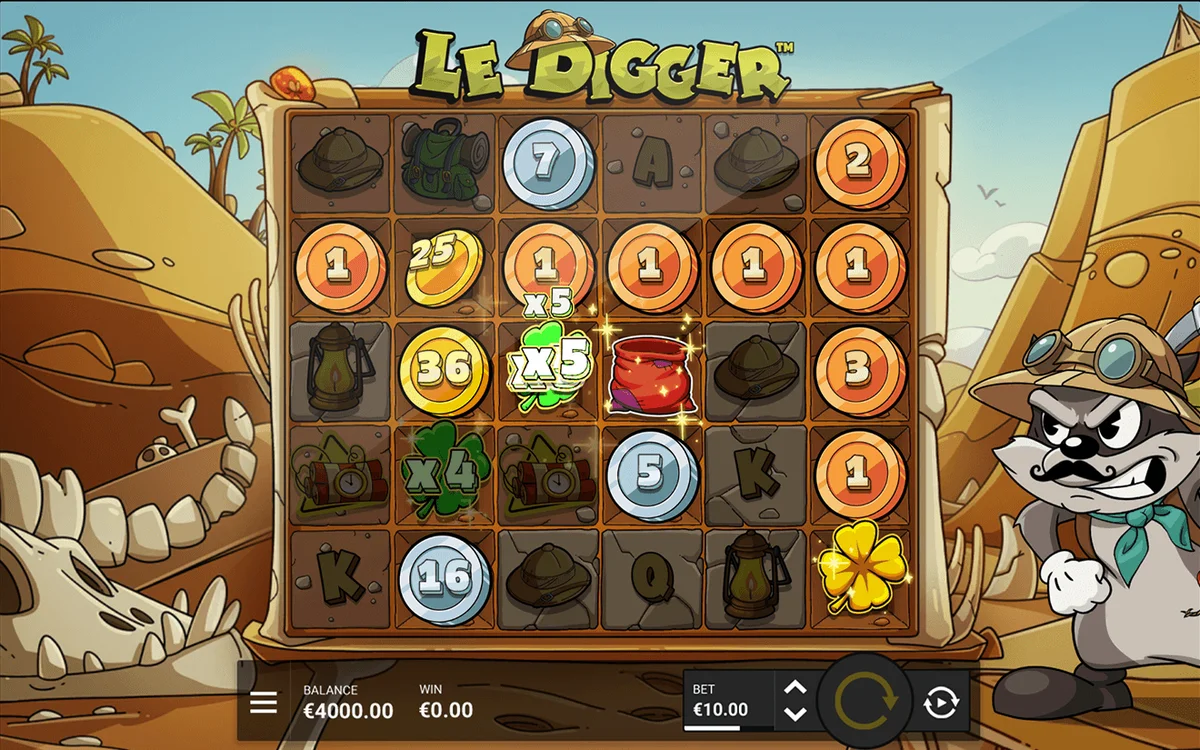
Le Digger is an online slot from Hacksaw Gaming. Its archaeological theme follows Smokey and a grid with three layers of content. Svenska Spel describes the game as six-reel cluster pays, and the official artwork shows six columns and five rows. Matching-symbol wins start a removal sequence; the distinctive part is what those removals uncover underneath. This is a game about reading a changing board, not choosing where a character should dig.
The defining structural fact is that the game has three layers. The first two layers contain the regular paying symbols, free spin scatters and Wild Dynamite symbols. The third and deepest layer is where Golden Reveals live: coins, clovers and collectors. This means the game has a vertical dimension most slots lack. A symbol you see on screen may be sitting on top of two more layers of content, and clearing your way down is the core loop.
For a Danish reader, the practical identity check is simple: open the game's info or help panel inside whichever client you use and confirm the provider name reads Hacksaw Gaming and the title reads Le Digger. Operator skins and lobby thumbnails can vary, but the in-client rules screen is the authoritative description of the version you are actually playing. Everything in this guide describes the provider's published mechanics; any local configuration differences, such as stake limits or return settings, belong to the operator and should be verified in that panel rather than assumed.
The Three-Layer Dig: How a Win Excavates the Board
The three-layer system is the heart of Le Digger, so it is worth understanding precisely. Layers one and two hold paying symbols, free spin scatters and Wild Dynamite. Layer three holds the Golden Reveals. When you land a winning cluster, the game does not merely remove the symbols in that cluster. According to the provider, a win removes all regular paying symbols of the winning type anywhere on the board, including instances that are not part of the cluster, and it also removes one layer behind those symbols.
Imagine a hypothetical board with nine lantern symbols. A group qualifies for a win under the client’s paytable, while other lanterns sit elsewhere. The provider’s rule removes all nine regular symbols of that winning type, and one layer behind each of them. If six positions were on layer one, those six expose layer two; three positions already on layer two expose layer three. Nine positions have advanced by one layer each. The example assumes a qualifying win; it does not establish the minimum cluster size.
This is why the paying group and the cleared area need not look identical. Some symbols disappear even though they were outside the group that made the win. That disappearance follows the type-wide removal rule; it does not by itself prove that each removed symbol received an additional payout. Read the award in the win display separately from the number of positions excavated.
After removals, new layers and symbols appear to refill the board, and only then does the next possible event, Smokey's dynamite, enter the sequence. Order matters: dig first, refill second, dynamite third.
Sources for this section: provider
Follow one position through the three layers
An explanatory model, not a playable slot. Each button shows the next stage at one position after a qualifying removal. Actual symbols and outcomes vary.
Layer 1 · regular symbol
The position starts at the top layer. A qualifying win or dynamite can remove its symbol and expose the layer underneath.
Payout, depth and net result
A win amount and a change in depth answer different questions. The amount tells you what that event awarded. Depth tells you which layer is now visible at a position. More excavation can make the animation busier without guaranteeing a larger final return. A useful explanation of a round should describe both, then use the settled total to calculate its money result.
For a hypothetical example, suppose a normal entry costs 10 kr. and the completed round returns 4 kr. Several positions reached Golden Reveals along the way, but the net result is still 4 − 10 = −6 kr. Another 10 kr. entry returning 9 kr. has a net result of −1 kr. The second loses less money, whatever the boards looked like. Neither is a profitable entry just because the game displayed a win.
Within the illustrated removal sequence, one position can be further down than its neighbour. A lantern disappearing at layer one exposes the second layer; the same type disappearing at a position already on layer two exposes a Golden Reveal. This is a description of the current sequence, not a claim that accumulated depth carries into a later paid spin. The provider summary does not supply a complete reset specification.
When learning the interface, pause your interpretation at the end of the sequence. Check the final returned amount rather than adding every number that flashed during animations. A running total may already include earlier awards. Counting that total and those awards again would invent money that the balance never received.
Sources for this section: provider
Smokey's Dynamite and the Wild Dynamite 3x3 Blast
Dynamite is the second excavation tool, and it enters the sequence at a specific moment: after new layers and symbols appear following a win, Smokey may throw dynamite. The word 'may' is the provider's own qualifier, so treat the throw as a possible event, not a guaranteed step in every cascade. When it happens, the dynamite removes the affected symbols and removes a layer behind them, functioning like an extra, symbol-agnostic win for digging purposes.
If dynamite affects a Wild Dynamite symbol, the provider describes a 3 × 3 symbol clear around it. Picture a square rather than a line: the effect is local to that area, unlike a win that removes a regular symbol type across the board. The exact treatment of overlapping blasts and edge positions belongs to the full client rules; a nine-cell sketch is a geometric explanation, not a guaranteed nine-symbol outcome.
Do not read the presence of a Wild Dynamite as a completed blast. The described interaction requires dynamite to affect it. The two things to watch are the arrival of the throw and the resulting clear. A symbol on the board, an activated feature and a final credited win are three different stages, even when they happen rapidly in one animation.
A win can remove a layer at a position, and a later qualifying dynamite event can remove another. Our three-layer model separates these steps so the depth change is easy to follow. It fixes an illustrative sequence rather than sampling the game’s randomness. It cannot tell you how often both events occur, which board is best, or whether a future round will reach a coin.
Sources for this section: provider
Read the Golden Reveals

Coin
A cash prize revealed at the third layer.
Clover
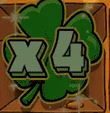
Boosts nearby coins or all coins, depending on the clover.

Collector
Collects coins and already activated Collectors.
Golden Reveals: Coins, Clovers and Collectors on Layer Three
The third layer contains Golden Reveals: coins, green clovers, gold clovers and Collectors. These are distinct objects with different roles. Coins award cash prizes. Clovers boost coin values. Collectors collect coins and activated Collectors. The provider does not say a coin is worthless without a Collector, so it would be wrong to interpret every visible coin as a prize that must still be rescued.
A nearby-coin effect and an all-coin effect have different reach. To understand that difference, imagine illustrative coin values of 1, 2 and 5 units. If an illustrative doubling applies only to the 1 and 2, the displayed values become 2, 4 and 5, totalling 11. If it applies to all three, they become 2, 4 and 10, totalling 16. These are teaching values, not a verified coin table or a claim about a particular clover colour.
A Collector can also collect an already activated Collector. That rule means its input can include a value created earlier in the sequence. It does not establish that coins disappear after collection, that value is paid only once, or that the last Collector replaces all prior awards. Those settlement details require the complete help panel. Use the settled round total instead of constructing your own total by guessing the animation order.
The cropped illustrations below come from Hacksaw Gaming’s promotional screen. They let you recognise the coin, clover and bag-shaped Collector before a busy reveal sequence starts. Their visible euro controls belong to that artwork. They are not a Danish-currency session or evidence of a result achieved by this guide.
Sources for this section: provider
Tomb Service, Dig It and Gold Digger: Three Scatter Thresholds
Le Digger has three distinct free spin bonuses, selected by how many free spin scatters trigger the feature. Three scatters award Tomb Service, four award Dig It, and five award Gold Digger. Each has its own mechanism, so the scatter count is not just a difficulty dial; it changes what the bonus actually does.
Tomb Service, the three-scatter bonus, offers a choice: gamble, or take 10 free spins. Its signature mechanic involves a Dynamite Collector that activates at the end, and a UK operator listing notes that Tomb Service collects winning Wild Dynamite symbols during the round. Read that as an accumulation bonus: what you gather during the spins feeds a collector event at the finish.
Dig It, the four-scatter bonus, also offers the gamble-or-10-free-spins choice, but its mechanic is a Blast Bar. Per the operator listing, the Blast Bar fills with removed symbols, and when the bar is full it upgrades the minimum coin type. That is a scaling mechanic: the more removal happens during the round, the higher the floor on coin values becomes, so deep, removal-heavy rounds compound in value.
Gold Digger, triggered by five FS symbols, gives 10 free spins with five dynamites on every spin. Those are concrete differences you can recognise without inventing a bonus win rate. Five throws are not automatically five different positions, fifty coin awards or a guaranteed profitable feature. The provider describes a Gamble choice for the two lower triggers but does not list one in its Gold Digger summary.
The practical takeaway is that the three bonuses reward different things: accumulation, removal volume, and raw dynamite saturation. Knowing which one you triggered tells you what to watch for.
Three triggers, three different features
| Bonus | FS symbols | Initial free spins | Distinctive mechanic |
|---|---|---|---|
| Tomb Service | 3 | 10 | Dynamite Collector activates at the end. |
| Dig It | 4 | 10 | A full Blast Bar upgrades the minimum coin type. |
| Gold Digger | 5 | 10 | Five dynamites on every free spin. |
The provider offers a Gamble choice at the three- and four-FS entries. Five FS triggers Gold Digger. No probability or expected-return comparison is implied.
Gamble or 10 free spins: read the actual choice
At the three- and four-FS triggers, the provider offers a choice between Gamble and 10 free spins. Taking the spins selects the described Tomb Service or Dig It feature. Before choosing Gamble, the useful information is what outcomes it can produce, whether their probabilities are shown and what happens to the original feature after each outcome.
Those terms have not been verified in our opened client, so no odds table or recommendation is attached to this guide. In particular, do not assume the choice is double-or-nothing, a free upgrade or a guaranteed move to Gold Digger. A familiar button name can conceal a different rule in another game. Read this game’s own help and the actual offer before confirming.
Even a known probability would not be enough to rank the choice if the values of the possible bonus outcomes were unknown. A count of free spins is not a guaranteed cash amount: ten spins can settle at different totals. Comparing an unknown random feature with another unknown random feature requires more than multiplying the spin counts.
If you are trying to understand a shared result, record which bonus started and whether Gamble changed it. “A Le Digger bonus” is too broad to compare meaningfully. The triggered feature, selected choice, full entry cost and final returned amount together explain much more than a screenshot of the largest number.
Sources for this section: provider
Working Out What a Paid Mode Really Costs
Separate three numbers before accepting any enhanced entry: the base stake, the quoted price factor and the full amount charged. Our Danish price list is not verified, so the examples here teach the calculation rather than advertise a mode. A player discussion mixes a 0.40 base, a 5× description and a 1.20 charge. Those cannot all describe a simple price multiplier: 0.40 × 5 is 2.00. A chance multiplier and a price multiplier can refer to different things; the post alone does not resolve which was intended.
The method is a three-step check. First, note your base bet, say a hypothetical 10 kr. Second, read the multiplier or price shown on the mode button, say a hypothetical 5x. Third, multiply: 10 kr. x 5 = 50 kr. per spin in that mode. Then sanity-check the result against the displayed total before confirming. If the screen shows anything other than 50 kr. for those inputs, the multiplier does not mean what you assumed, and you should stop and re-read the mode's description rather than proceed.
Also distinguish buying an entry from receiving its result. At a hypothetical 50 kr. price, a round returning 30 kr. has a −20 kr. net result; one returning 80 kr. has a +30 kr. result. A return above the ordinary base stake can still be a loss against the full price. The calculator below the guide accepts the price you actually see, so it does not need an invented Le Digger price preset.
Treat every multiplier in this section as an illustration of method, not a verified Le Digger mode price. The only authoritative price is the one your client displays at the moment you press the button.
Sources for this section: reddit-rtp
RTP and the loss-recovery misconception
A player forum thread about Le Digger asks when the RTP will 'kick in' after a run of losses, and the replies include the claim that other players' wins affect what is left for you. Both ideas are wrong, and correcting them is the most useful arithmetic in this guide. RTP, return to player, is a long-run statistical average measured over a very large number of rounds across all play. It is not a balance the game tracks per person, and it carries no memory of your session.
The rules do describe state changes inside a bonus, such as a Blast Bar upgrade. That is different from a claim that losing ordinary rounds makes the game owe a repayment. Neither the stated RTP nor the player’s loss history proves that the next paid entry has become favourable. We have no verified game-level probabilities with which to calculate a recovery time.
The discussion also contains an unsupported claim that other players have used up the available wins. It is an anecdotal explanation, not a rule documented by the provider. Other people’s screenshots cannot establish your next outcome or the RTP setting in your client. A reproducible accounting record is more useful than either a “hot slot” claim or a “wins are gone” story.
Svenska Spel and Grosvenor list 94.29% in Sweden and the UK. As an illustration using that foreign configuration, 10,000 kr. of fixed planned turnover has a theoretical average return of 9,429 kr., leaving an expected cost of 571 kr. This is not the verified Danish setting, a session forecast or a guarantee that playing longer recovers losses. The dedicated RTP guide explains the denominator and the limits of a short sample.
Sources for this section: reddit-rtp · svenska
Where Le Digger Appears for Danish Players
A Danish operator, Royal Casino, runs a public Le Digger page that presents two clearly labelled paths: 'Spil for sjov', play for fun, and 'Spil for penge', play for money. The existence of both labels on one page is itself useful information for a Danish reader, because it tells you the operator distinguishes a free mode from a real-money mode at the lobby level, before any launch. If you want to learn the three-layer mechanics without staking anything, the 'Spil for sjov' entry is the one to look for.
Honesty about limits matters here. The listing was read as a public page; no authenticated game launch, account action or payment step was performed, so this guide cannot tell you what the logged-in experience, the cashier flow or the exact stake ladder looks like at that operator. What the public page does establish is availability: Le Digger is listed to Danish visitors by name, with both modes advertised.
Availability can change, and this guide's affiliate or listing coverage should be read as a snapshot, not a guarantee. Operators rotate catalogues, and a game present today can be delisted or region-restricted later. The reliable habit is to search the operator's own lobby for 'Le Digger' and confirm the provider is shown as Hacksaw Gaming on the game's info screen before assuming you have found the same title described here.
If you play at more than one Danish site, repeat that check at each one. The game name can be identical while the underlying configuration differs between operators, which is exactly why the version checklist later in this guide exists.
Sources for this section: royalcasino
Trying the Demo: What Happened and What You Can Still Learn
The natural place to try Le Digger for free is the provider's own game page, which embeds a demo client. In this guide's attempt, the demo did not reach a playable state: the session ended with a wallet connection failure, the error 'Connection lost to wallet - please try again' appeared, it was acknowledged once with the on-screen OK button, the same error repeated, and the session was stopped. Zero paid or demo rounds were played. That is the complete demo status, and it means nothing in this article is drawn from first-hand spins.
A wallet error means the client could not establish the required game-session connection in that attempt. It does not indicate a debit or a lost round. Use the official provider entry and its own visible consent and age controls. If the same error repeats, stop and return later or check the operator’s own free-play entry; do not assume changing a balance display, downloading an APK or installing a predictor would fix the connection.
If you do get the demo running, use it with a checklist rather than spinning idly. First, open the paytable and confirm the clover behaviour, since the provider only commits to clovers affecting nearby or all coins. Second, watch a few wins and verify the type-wide removal rule: does a win really clear that symbol everywhere, including outside the cluster? Third, note whether Smokey's dynamite appears only after refills, as the rules describe.
A demo is a UI model of the real game, useful for learning rules and flow, but it is not evidence about what real rounds will pay. Treat it as a classroom, not a forecast.
Sources for this section: provider
A Version and Configuration Checklist Before You Stake
The same title can appear in several markets. Before interpreting a quoted number as your own configuration, identify the actual client. A public lobby page is useful for locating the title, but it does not display every rule behind the launch. Some checks may require a working demo or account access; this guide does not promise that every operator exposes them before login.
Step one: confirm identity. The info panel should name Hacksaw Gaming as provider and Le Digger as title. Step two: find the RTP figure in that panel. Two foreign operator listings, one Swedish and one UK, both show 94.29%, but neither is a Danish configuration, so the only number that governs your play is the one your Danish client displays. If the panel shows a different figure, that figure, not 94.29%, is your reference. Step three: read the stake ladder and any mode prices directly off the interface, and verify the arithmetic yourself, base times multiplier, before enabling anything.
Step four: check the bonus descriptions. The rules screen should describe Tomb Service at three scatters, Dig It at four and Gold Digger at five, with the gamble-or-10-spins choice in the first two. If the wording differs materially, you are looking at a different ruleset than the one this guide describes, and you should trust the screen. Step five: look for the clover explanation in the paytable, because the provider's public material only says clovers affect nearby or all coins; the client paytable is where the exact colour behaviour, if stated anywhere, will appear.
Finally, check the currency next to the stake and balance, then match any price example to that same unit. The artwork here uses euros; the calculator uses illustrative kroner. Neither proves the denomination in a particular Danish session. Keeping title, provider, configuration and money units together avoids comparing one game’s rules with another client’s cost.